 News
SAtRes to move to Ulm University
News
SAtRes to move to Ulm UniversitySAtRes to move to Ulm University
September 8, 2026
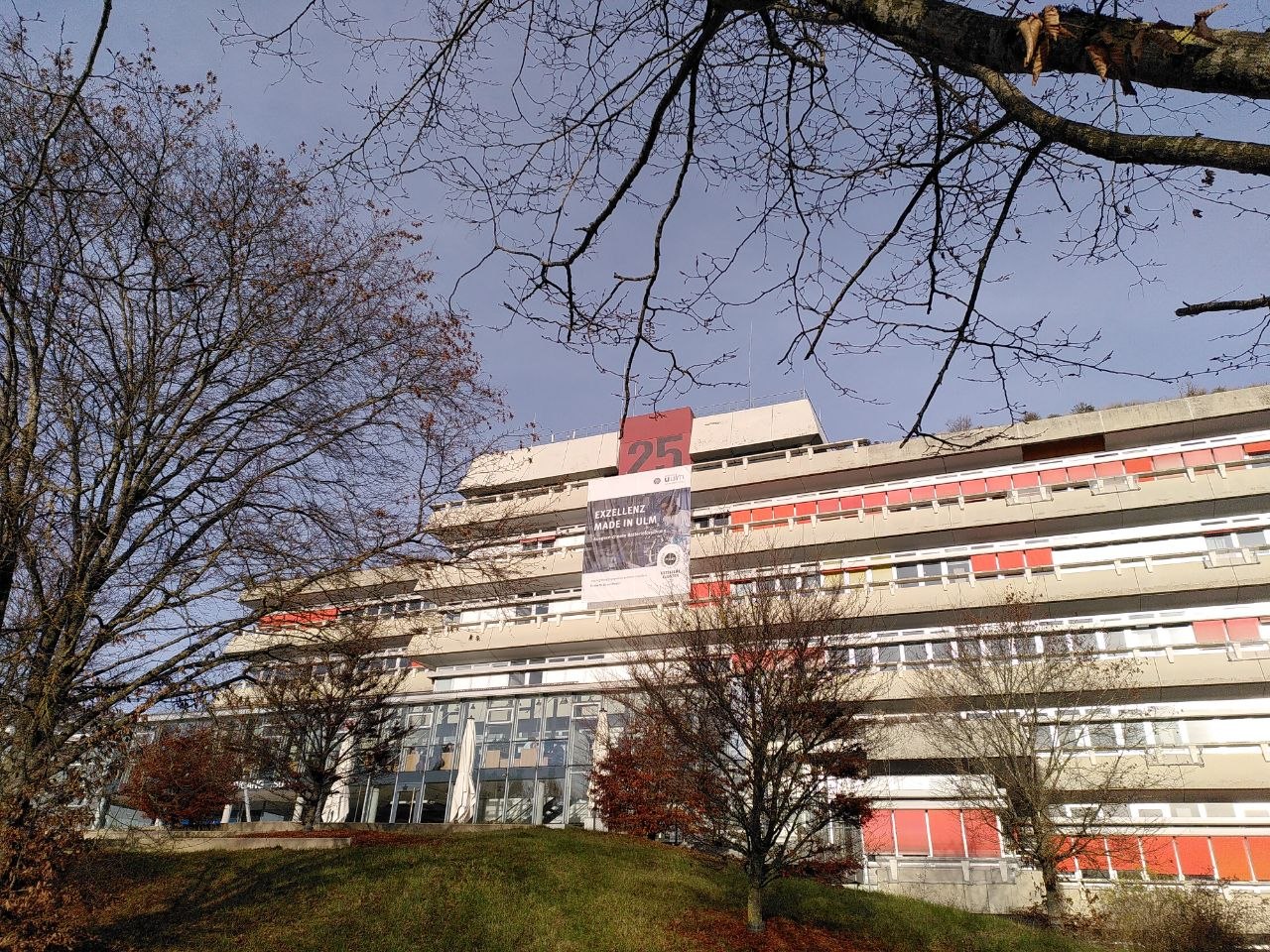
One of the buildings of Ulm University at its campus on the Eselsberg
We are delighted to announce that the Faculty of Engineering, Computer Science and Psychology at Ulm University (UUlm) and Dominik Schreiber (SAtRes) have agreed to establish the DFG-funded Emmy Noether research group “Scalable Automated Reasoning” at UUlm. As such, the SAtRes group is set to move to UUlm later this year. Substantial funding is provided by the German Research Foundation (DFG) over a total of six (3+3) years, supplemented by our other third-party projects as well as starting funds from UUlm itself.
Ulm University is a research-intensive German university founded in 1967, known for its strengths in medicine, natural sciences, engineering, and mathematics/economics. Its compact, highly interdisciplinary campus fosters close collaboration between students, researchers, and industry partners, including strong ties to companies in the region.
Ulm University’s computer science department has a distinguished history in symbolic AI and propositional satisfiability, with which we have already had various touching points. These include the influential work of Uwe Schöning (now emeritus), whose book Logik für Informatiker first sparked Dominik Schreiber’s passion for propositional logic during his studies, as well as the AI institute’s excellent research on automated planning (initiated by Susanne Biundo), whose alumni we connected with in the context of workshops and competitions on hierarchical planning.
Today’s computer science institutes at UUlm continue to advance both theoretical and applied dimensions of computational logic: Jacobo Torán’s group explores the fundamental topic of proof complexity whereas several other groups apply automated reasoning methods to tackle diverse challenges. These range from querying and repairing ontologies for formally precise knowledge representation (Birte Glimm) to modeling and verifying complex software architectures (Robert Heinrich, KIT alumnus) and designing embedded systems through hybrid optimization (Michael Glaß). The department also bridges symbolic and sub-symbolic AI, tackling cutting-edge topics like explainable medical AI (DFG research training group KEMAI) and the explanation and verification of neural networks (Gesina Schwalbe).
The unique combination of rich interdisciplinary synergies, welcoming colleagues, an engaged student community, and Ulm’s vibrant academic and cultural environment makes Ulm University an ideal new home for our group. We will specifically be part of the Institute of Theoretical Computer Science – joining the research groups of Enno Ohlebusch and Jacobo Torán.
Our move away from KIT, which we expect to take place in November, will conclude the KiKIT young investigator group after two successful and exciting years. We are very grateful to the KiKIT board for funding this group and hope to maintain strong ties with researchers (and, by extension, students) at KIT.